
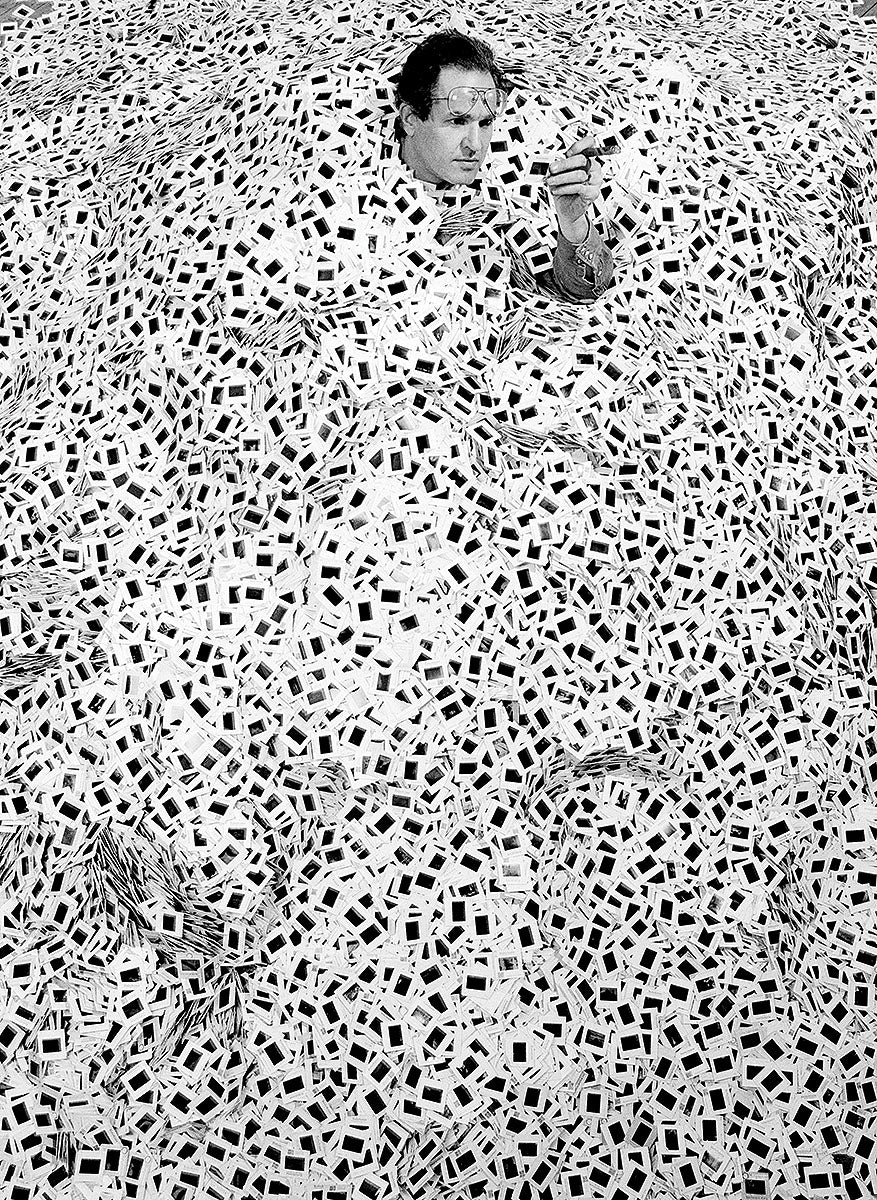
Jay Maisel shot Nikon for more than 50 years, starting with the Nikon F in 1959. When I interviewed him in 2011, he could reach from a 14mm to a 2000mm, but he walked the street with a single 28–300mm zoom. Equipment interested him only as far as it helped him see. That is exactly why his choices are worth knowing.
The cameras
| Camera | What Jay said about it |
|---|---|
| Nikon F (1959) | His first Nikon, bought the year it came out. He still owned 16 of them. |
| Nikon F2 | Skipped it. He felt it had too much electronics. |
| Nikon F3 | Eight of them, after his repairman, Marty Forsher, told him he had beaten his Fs too hard to keep fixing. |
| Nikon F4 / F5 | Four or five F4s and one F5. |
| Nikon D1 | Sam Garcia put one in his hands. After two weeks he never shot film seriously again. |
The lenses
- Early kit: a Nikon 50mm, a non-Nikon 90mm macro, and Zeiss Sonnar 180mm and 300mm lenses. He moved to Nikon's 180 when it arrived.
- Fast glass he loved: the 300mm f/2.8, 600mm f/4, 200mm f/2, several 50mm f/1.4s and the 58mm f/1.2.
- The oddities: a 1000mm f/6.3 catadioptric (mirror) lens with a working diaphragm, which he said Nikon's own staff didn't believe existed, and a 2000mm f/11. In New York he could only use the 2000mm about a dozen days a year, because heat shimmer softened everything.
- The one he didn't like: the 43–86mm, Nikon's first zoom.
- The one that changed everything: the AF-S 28–300mm. Before it he carried a 70–300mm plus a 24–70mm in a belly bag, and rarely bothered to switch. With the 28–300mm he could go from wide to long without changing anything. He called it sharper than any lens he had used.
Why a telephoto
Jay didn't like the word "compose." To him, composing meant controlling what's in front of you. On the street you're framing and cropping. A long lens made that easier. A wide angle, as he put it, makes you responsible for a lot of real estate. He cared most about what sits in the center of the frame.
The point of all this gear
He owned everything from 14mm to 2000mm and used one lens. He kept the rest from his commercial years, when he felt he owed clients an answer to any situation. Shooting for himself, he chose what was easiest to carry, because, by his own account, he was reactive, not proactive. That's a useful thing to remember the next time a new lens looks like the answer.
Read the full conversation: "Jay Maisel: A Conversation About Seeing" on PhotoEducate